Showing posts with label satan. Show all posts

Wednesday, September 20, 2017

Malleus Interview Storm of Witchcraft

Malleus
Storm of Witchcraft
Blood Harvest


Interview by hutch
  
Boston’s Malleus self-released a tape in 2016. Blood Harvest now resurrects the ornery seven tracks and commits this vile violation to tape, CD, digital and, of course, vinyl, on October 25th. Answering by email, The Hammer acknowledges an excitement of finally rereleasing Storms of Witchcraft. Blood Harvest has been great. We were actually pretty familiar with Rodrigo from his punk label Putrid Filth Conspiracy in the early 2000's. So when we made the connection that he was behind Blood Harvest as well, we were pretty psyched. Feel like he knows where we're coming from as far as our background and inspiration goes.”

Known professionally as The Hammer, the Malleus member reminisces about the origins of the mysterious Boston trio. “At that time, everyone we knew in the Boston punk scene was obsessed with Discharge and really raw D-Beat. So, all these uninspiring dis-clone bands started popping up everywhere which only fueled our discontent with the current state of punk. I was absolutely obsessed with the Satanic Rites tape (Hellhammer) and Discharge as well and decided that instead of just doing another boring D-Beat band, I'd take my obsessions in a different direction.”
That obsession spawned Storm of Witchcraft. “We spent a few years writing, really pouring over every little detail of the songs and trying to make the best possible demo we could.” The Hammer’s reluctance to spew retreads of worn paths has resulted in a classic release. Malleus’ sound embraces Discharge’s legacy of low-tuned sonic exuberance with crushing riffs which summon Hellhammer/Celtic Frost, and Bathory. The Hammer takes pride in this release. “A lot of time and effort went into making Storm of Witchcraft what it is.”

The sound is brutal; low and gritty, but mixed and mastered well. Clear, clamorous and, well, not shitty. Too many d-beat or black metal bands think crappy production is a hallmark. I hate that antithetical thinking. Be gnarly, be subversive – but still sound good. The production is thorough, elevating each component while keeping the music raw and crusty. Hammer reports, “We recorded with Chris Corry of Magic Circle at his practice space and we had our friend Ryan (Side Two Studios) do the final mixing and mastering. The whole thing took 2 days to record. We did the music on one day, vocals on the next. CC was recommended to us by a mutual friend and although we didn't know him personally at the time, we were familiar with him through growing up in the same circle of the local punk scene. We did know that CC was obsessed being able to emulate tone and capturing the same sound of bands from the past so we thought he'd be able to nail early Hellhammer/Frost, and we think he did with Storm of Witchcraft.  We wanted to avoid a lo-fi sounding demo at all costs but still come out with something that was abrasive, raw, and energetic. The music itself is super riff-driven and we try to vary the tempo as much as we can and all that would be completely lost if we decide to record this with one mic and a 4-track.”

The opener, “Winds of Wrath / Ire” aurally depicts a chilling wind, gathering intensity, leading to a panning of eerie sounds. This two minute seduction is quickly interrupted by a crashing of a grinding riff, punching and punching. The final minute of the “Ire” portion is a flogging mid-paced riff that pounds away. “Blackened Skies” begins harkening an epic, but quickly charges forward with purpose. A twisting, belligerent riff in the middle, for the chorus, is malevolent and bold. While many have emulated the aforementioned forefathers of black metal, Malleus has remarkable accuracy in combining homage and originality. In a genre where the majority of ideas are simply reworked executions of the masters, Malleus take the Discharge model and apply it to the Satanic ferocity of Bathory and Hellhammer. Again, even I grow weary of citing Tom G and Quorthon’s early work; pining to infuse a wider reference spectrum. But these just fit so perfectly. The music is invigorating in two ways. The pure spirit of the music but also the refreshing aspect of new takes on this style.
Hammer advises when looking to forefathers to be sure to inject one’s own fluid into the mix. And do it well. “Just keep the focus of the band very specific rather than drawing from all these various sub genres and convolute the sound and direction of the group. Nowadays, it's so easy for anyone with a computer to record their own demo and everyone needs instant gratification so instead of taking their time to create something worthwhile, they rush into making a demo and posting it on the Internet. Then they complain when it gets passed over and people move on to the next shitty demo.”

Besides the redundant riffs of d-beat clones, The Hammer also complains of uninspired metal lyrics of vapid party anthems. “I would hope that Storm of Witchcraft and anything else Malleus does evokes more emotion or provokes deeper thought than just wanting to party or get fucked up. If people can listen to our music and gain some sort of enjoyment or satisfaction from it, that's great. But for us, metal has always been more than the soundtrack to heavy drinking. As far as Storm of Witchcraft goes, It's obvious that we take direct cues from the likes of Quorthon and Tom Warrior for our sound but in the early 80's, bands basically had Overkill (Motorhead), Lightning to the Nations (Diamond Head), and Hear Nothing, See Nothing, Say Nothing (Discharge), and look what they came up with so what can we do with those records? And that's always been our approach. Just keep the focus of the band very specific rather than drawing from all these various sub genres and convolute the sound and direction of the group. Nowadays, it's so easy for anyone with a computer to record their own demo and everyone needs instant gratification so instead of taking their time to create something worthwhile, they rush into making a demo and posting it on the Internet. Then they complain when it gets passed over and people move on to the next shitty demo. A lot of time and effort went into making Storm of Witchcraft what it is.”

The Hammer reports Malleus’ plans to finally spread their unholy gospel. They are embarking on their first tour of the West Coast with Witchtrap from Colombia, whose 2015’s, Trap the Witch, is equally carnivorous. They join Hirax, Xoth, and Witchhaven for Seattle’s stacked Famine Fest, Day 1, Sept. 22nd. Hammer continues, “We will support Merciless from Sweden on their only East Coast show in Brooklyn on October 20th with Antichrist Siege Machine. February 16th, (2018) we will be supporting Morbosidad and Blaspherian in Baltimore, MD.” Other shows aren’t booked, but Malleus is ready to mesmerize when they do. “We're going to continue to play anywhere people will have us. Hoping to get in the studio again by this fall/winter to record a couple tracks for a 7 inch.” 
The back to back tracks, “Demonology I” and “Demonology II” combine to last over nine minutes. Part I drags through its parts in a true Celtic Frost atmospheric sludge. Slow and ringing guitars set the pace. The thunder rhythm section dutifully obliges within a few minutes. We then are treated to a stomping bridge with a solid groove. Part II again delves into a long strain of feedback before a speed-fueled riff propelled by unrelenting drums. “The Wolf” follows the same pattern for its three minutes. “Act of Faith” is a slower, heavier jam. The Celtic Frost vibe resurfaces, that same tone and distinguished guitar sound CC extracted to emulate Tom G Warrior. The low end and bass drums weigh in, boasting a sinister gravity to the track. The imagery and lyrics all tie in with wolves and demons and faith.

Snarling all this demonic terminology, Malleus have a platform to share their views. The Hammer is concise and candid. Again, The Hammer eschews clichés and token references for an opportunity to expose his deeper beliefs. “True evil doesn't actually exist. All people are slaves to their needs and desires and only act in a way to satisfy them, even "good" people.  Altruistic people are motivated by innate feelings of empathy in which they feel pain when others suffer and feel good when others feel good. In the end, everyone is motivated by internal selfish desires. If evil was only used to describe actions that cause more harm than good, I could get behind it but too often evil is just a word used to describe others whose actions conflict with one's own. That being said, many groups such as Christians truly believe in evil so the word can be useful if you're trying to antagonize them.”


Wednesday, May 31, 2017

Satanarchist stream new LP at Noisey

I recently interviewed Portland, OR. I'll post that next. Before you read, open up Soundcloud in another tab and press play. Noisey is streaming their new LP, Fire Against the Wall for y'all's enjoyment.

They thrash metal crust punk barrage is belligerent and bountiful. The duo crush as the blaze through their pugnacious opinions on politics and religion.

give a listen and check out my interview:
this is the original email Q&A form. To find the extracted, written interview by me - look for New Noise Magazine Issue 33 in print. cheers.

Satanarchist Interview

Satanarchist
First Against the Wall
Self-released.
drummer/lyricist, Mark Nunziata; guitarist/vocalist, John Edwards

Interview by hutch for New Noise magazine

https://satanarchist.bandcamp.com/

Is the duo thing out of necessity or choice? What does Satanarchist bring as a duo that differs from if you added a bass?

Mark: We started playing together in 4-piece black metal band Spectral Tombs almost 7 years ago, and Satanarchist was simply born from all the times that we were the only two available to practice. If the other dudes couldn’t make it, the two of us would still get together and mess around. That’s how most of the first record was written, as a casual side project. When the other members of Spectral Tombs both stepped out of the band, coincidentally at the same time but for unrelated reasons and on good terms, we just decided to keep going and focus on this. We considered finding other members for a while but settled on remaining a two-piece for a number of reasons. I’d been in a few duos before and always appreciated how easy it was to make decisions, schedule shows and practices and all that, one line of communication and no dead weight.

John: As far as what being a two-piece brings, we get a lot of feedback after our live shows that we make a shit ton of noise for two people. People are like “holy shit I can’t believe how full your sound is,” or “I had no idea there were only two of you until I got a view of the stage.” Sometimes people say we need a bass player, but those people are usually bass players.

Mark: The only drawback to being in a two-piece is that we always have to load and unload the like five people’s worth of gear we use.

How is atheism/Satanism important in 2017’s society?

Mark: As the institution of religion gains traction in politics and society, it becomes increasingly important to resist it and support systems of belief based in radical ideas such as ‘facts.’ People can believe whatever they want but not if those beliefs start creeping into policy or affecting other people’s rights. With so many people and politicians using religious arguments to push oppressive attitudes and defend oppressive actions, we have a responsibility to stand up and call bullshit. I am disgusted by the injection of religious ideals into politics and our personal lives, things like health care, science, education and equal rights for people who aren’t straight cis white men.
What strengths do you derive from these beliefs?

Mark: We don’t reference satanic imagery or atheism because it’s the metal thing to do; we do it as a means to communicate our revulsion toward the influence of religion in society. There’s a very real overlap between radical left politics and freedom from religion, and the relationship between them runs far deeper than just our name.

John: Hail Satan.

Mark: And fuck homophobia, fuck transphobia, fuck “pro-life” Christian assholes who cut food and healthcare for the poor.

In the promo – specific amps are listed, Is gear, or are specific brands, important to Satanarchist’s sound?

John: I don’t particularly care about brands and, like, boutique or vintage gear, but Engl makes the best sounding amps for the kind of metal we play… so I use two. The Ampeg SVT is pretty much industry standard and fills out the low end.

Mark: What’s almost more important than what we list is what we don’t list. We wanted to just write fun, fast, heavy shit that doesn’t rely on effect pedals or bells or whistles to make it sound good, just amps and riffs. When we started writing for Satanarchist we set a couple ground rules. 1: No doom. 2: No Pedals.
Is it a tough decision to not shop this around to labels and just release independently?

Mark: It was mostly a matter of circumstance. We wanted to have this album ready to go before our Canada tour, and we knew that if we took the time to shop it out to labels then the timeline probably wouldn’t work out. We reached out to a couple Canadian labels early on but never heard back so just decided to slam it out ourselves.

John: We’d be open to working with labels for our LP release of First Against The Wall though.

In 2017, what are the pros and cons of releasing a record yourselves?

Mark: We did our first CD and LP independently as well, gives us a lot of control and flexibility over timelines and whatnot but it is pretty expensive.  Of course it would be cool to have the distro and promotions power of a solid label behind us but we’ve just kept everything as DIY as possible from booking tours to finding floors to crash on to putting our music out. I’ve never worked with a label before so I can’t really speak to the comparisons.

John: From the get go, one of our main goals was to tour as much as possible and releasing our own stuff is just easy. We just make it happen. No one’s going to do it for us so we do it ourselves.

How did recording go?

Mark: By the time this prints I will have recorded drums at Haywire studios with Fester five times between four bands so I pretty much knew what I was getting in to.  The dude’s a wizard, he has a way of hearing your music better than you do, he’s a skilled engineer but always ends up lending invaluable input as a producer as well. We also booked more studio time than we usually do for this record so I didn’t feel as much pressure to nail everything on the first take.

John: Fester is pretty much the shit for recording metal in Portland. There are other people to go to… but why?
With production or mastering, ever a worry it would be too clean or polished? How much dialogue was there between you and Fester/Boatright along the way?

Mark: Brad at Audiosiege does amazing work so we pretty much just let him do his magic. Our only specifications we gave for this were a) make sure you can hear everything and b) make sure it has balls. We wanted it to sound good without compromising weight, and be heavy without compromising clarity. We feel like he came through pretty solid on both points. With Fester we spent far more time mixing it than I ever had on anything before so I’m pretty fucking stoked on how you can hear every little goddamn snare roll.  We worked on the mix over a half dozen sessions over a few weeks.

How do things look for your Canada tour?

Mark: We’re psyched to reunite with our brothers in Hard Charger. We met those guys last summer when we played four shows together on the east coast of the US and have kept in touch. They did all the legwork to book the shows and we’re grateful for the opportunity to play metal with them north of the wall. I think we’re covering like five provinces and playing in some really cool towns. I grew up in Vermont and loved Montreal when I was a kid so it’ll be rad to get to play there.

John: Hard Charger borrowed my backline for a west coast tour last fall and all I got was a bottle of whiskey so basically they owed me one. Best buds tour 2017.
What is it about the TVZ cover that stirs you enough to cover it?

John: We’d been talking about it for years. Have you heard Silver Ships of Andilar? The form and content, It’s basically asking to be a metal song. It’s a story about going to war on a boat, getting lost at sea and everyone starving and killing each other. Plus I’ve been listening to Townes Van Zandt my whole life, I was raised on it. My mom introduced me to his music as long ago as I can remember. When I told her we were covering one of his songs she was like “You’re going to ruin Townes.”  But he’s been one of my musical idols since I was young, so we did our best to do it justice.

Amended explanation of the title of the album:

First Against The Wall or "First against the wall when the revolution comes" is an echo of radical left sentiment toward members of the elite who will face firing squad after being deposed by popular uprising. References to the phrase or variants of it can be found scattered throughout radical and popular culture back to the 60's and 70's. We use it as an imagining of retributive violence against police, heads of state, businessmen and agents of the church who've committed injustices and atrocities against the people. It also invokes images of violence by the police which we find appalling and stand firmly against. In today's political environment, it is also intended as a a reference to Trump's border wall. Imagine Trump, Sessions, Ryan, Bannon, Spencer, McConnell et. al. facing a firing squad with their backs to a wall on the southern border. A band can dream.

Hutch would like to thank John and Mark for their time. Also Lisa Root at New Noise. Dave and Liz Brenner at Earsplit PR


Thursday, March 16, 2017

Deathwish Interview with Biddy

Deathwish
Unleash Hell
Beer City
Interview with bassist/vocalist, Biddy

Biddy, bass/vox; Guinea Pig Champion, guitar/vox; Jimmy Claypool, lead guitar;  S.W. Macleod, drums

Blasting out of Wisconsin and Minneapolis, Deathwish release their second LP, Unleash Hell, on Beer City early 2017. Their thrashy brand of the Motorcharge style has been honed here to a vicious surge. Biddy, bassist and vocalist, spoke with me after getting home from work. His frank admission to the allure of dark and rebellious music has become a life defining mission.
Biddy begins with his excitement for Unleash Hell. “This has better production, better written songs. The artwork is completely different but phenomenal. Our guitar player, Rob (aka Guinea Pig Champion) writes 90% of our music. Our first record took all the time in the world. So, now the pressure was on. Can we write a better record? I hope so…” jests Biddy. Biddy also plays in Wartorn and grabbed a new lead guitarist, Jimmy Claypool, who is from In Defence. That pedigree would ensure a better record.

“This is more aggressive. It rages more while being a little progressive, a little more precise.” Biddy’s lyrics demand the feral snarl of these heavy riffs. While he may not be writing the majority of the music, Biddy appears to be the director of the band; subject matter, musical direction, and tour planning all is his responsibility with this monster that is Deathwish.

Unleash Hell was recorded by Adam Tucker at Signature Sound Minneapolis. Tucker has been recording since the ‘90s. Biddy holds only admiration for Tucker. “He is the best I have worked with. Adam throws in ideas and they accentuate what we were doing, not pushing the song somewhere foreign. The process is smooth as glass.”

Deathwish had an April 2016 tour with MDC, their second tour with OG punks. First was Chicago, then looping through NY, PA, VA, GA, LA to eventually Fort Collins, CO. 34 shows in 35 days. “When I woke up the next day, I had to be at my mom’s for dinner. I didn’t know what state I was in. When MDC tours, it is the pedal to the floor. They give 110% and we are right there with them.” Biddy adds, “This past year, we played 100 shows with tours, that’s not including weekend gigs.” Deathwish will embrace the road to spread the gospel of Unleash Hell. They have upcoming tours in Europe eastern plus two fests. The band is also doing another future tour with MDC and DOA, plus a DRI tour coming. DRI took them out before and Spike (Cassidy) wants them to come out with DRI again.

The intent and motivation remains the same, to play demonic rock and roll and leave venues in their wake. Armed with new material that engages and punishes, Deathwish forged Unleash Hell with an even darker commitment. “This record was inspired by things I grew up on. That song (Rolling Stones’) ‘Sympathy for the Devil’, all the stuff that alluded to Satan; Sabbath, Maiden. I was into it even as a small kid. There is something about it which is very powerful. As a child I believed in that, because I grew up catholic. And they scared the hell out of you with fire and brimstone. But, as a small child, I was like, bring on the fire and brimstone!” Biddy was drawn to the dark elements of this oppressive religion not for shock value, but as a side effect of his defiant search for truth.

Biddy’s push toward the forbidden came from a rather natural reaction to how the world treated him. “I have a mental illness, Tourette’s. I have a mild case, dealt with it my whole life. I don’t experience happiness, just depression and mania. As a child, I had paranoia.” He quickly connects his disability to seeking out alternative answers. “The devil made sense when I was kid. The church tells you about a great God, giving people gifts. Here I am, suffering. Why? Does god hate me? What about children with cancer? What about wars? Where is God then?”

Biddy continues with the honesty of a kid, an aspect that has left a permanent impression. “Even as a believer, I was angry. How do you rationalize that? The Church’s explanations were never making sense. They never added up, just devoid of logic.” He continues to explore the contradictory stories in the Bible that most doubters question. “God says ‘Thou shall not kill’ but he floods the planet? Which is because he’s angry at people… that he created.” His skepticism is palpable. But having heard this example countless times, this isn’t the impactful moment. The following reveal is Biddy’s true stake in the fight. “At same time, I am highly emotional. My mental illness makes me more emotional or depressed.”

Defiance is a genetic propulsion for Biddy. He immediately offers the heroic stances of his ancestors. “The rebel was engrained in me. I am a German Jew and Ukranian. We didn’t do so well in WWII. My great grandfather was thrown between two train tracks because he told the Brown shirts to go fuck themselves. The other side of my family were Ukranian farmers who said ‘fuck Stalin, because he’s starving us’. And even others were rounded up into camps as Gypsys. My family is made up of rebels. We did not listen to the status quo. If something doesn’t make sense, its bullshit. And we are going to call out the bullshit.”

“In the garden, Satan told them they were naked. Satan told them the truth. As an agnostic, I know Satan is probability not real. But, if he was real, God made him that way only to have a scapegoat to blame. That’s where I identify, because I was born with mental illness, someone society can blame. In private school, I had learning disabilities. But I didn’t have learning disabilities according to them. I had the devil in me. So, they were going to beat the devil out of me. I got the shit beat out of me all the time.”

Biddy reports his parents, “being totally cool”, out of those environments. The understanding parent was often missing from the equation in the ‘80s. Parents were still very much part of the system, never siding with a pugnacious child. But still the trauma of abuse of these institutions had impressed their brand into Biddy. He reflects on their distorted logic. “Oh you can’t spell? You have a disorder? We’ll put you in a harder class. All the solutions were backwards back then.”

“Kids say oh things are out of control these days,” Biddy expands. “No. Things were way more dangerous when I was kid.” We quickly reminisce about how exactly close minded the general public was in the ‘80s and early ‘90s. But instead of dismissing this new generation, as a child of rejection, Biddy takes an empathetic approach. “I am going to defend the millennials. The joke is (about millennials) that ‘oh they are so easily offended’. But, I couldn’t have blue hair back in 1985 without being called homophobic slurs and being beat up. I can’t tell how many times I got hospitalized because I was a skateboarder. People couldn’t handle me eating in a restaurant in the mid 80s because I had a blue Mohawk and two pierced ears.” Biddy then recounts a few specific attacks. Luckily he was armed with an alliance with his parents. But when his father called authority in one of these incidents (which equates to attempted murder upon Biddy’s 16 year old self by an adult), “the cops said, ‘yeah but isn’t your son a skateboarder?’”

Biddy had always had music as an outlet and weapon of retaliation. This album is a sharper sword that Out For Blood. Unleash Hell is reflective of that sentiment’s cinematic origin, gladiators with nothing to lose attacking the system’s corrupt leaders. The fury in Deathwish’s music attacks with speed and precision and killer riffs. The term Motorcharge (combining the sounds of Motorhead and Discharge) is often used, but Deathwish pushes even those limits. “I think we are different. We have a more metal influence like Disfear, Toxic Holocaust, and Midnight.” Not that Biddy denies pure adoration for Motorhead. “I had been seeing Motorhead since I was a kid. But then when I saw Inepsy, I thought ‘this sounds like Motorhead, but they’re killing it’.”

Biddy doesn’t want to fit into a genre slot. He wanted to join a band but d-beat or Motorcharge or crust usually come with fettered characteristics. He knew the style which he wanted, especially after playing in a slower, doom/stoner band. Biddy wanted an electric rush; grit and rage to be the driving force. “But, I couldn’t because they made up 800 rules of how it had to be. When I play in bands, I ask bandmates ‘what do you want do to do?’” He takes their response and pushes, “Let’s do that, plus three more things.” Biddy continues, “You can see the excitement on their face to start to begin with what their passionate is. I’m trying to play with the most passionate people I can find.”
“I’m addicted to rock and roll. That is my drug. It is what I will do until the day I die. You can’t OD on it. Well, we’ll find out.” Playing guitars since he was 15, Biddy has always used music as a release. But 30 years later, it’s more of a lifestyle than ever. He still works, as a barber. I comment on the recent resurgence of barber shops with the cool kids. “That’s just more competition. I have been doing this for 25 years.”


Despite his dedication to his art of haircutting, his music will always be his primary focus. “I’m playing more than I have ever done. And have got to tour with my favorite bands; Municipal Waste, Oi Polloi, DOA, MDC, DRI, Hellshock. How the fuck did I get this lucky? If I end up in a stroke tomorrow, it would balance out.”


Cheers to Biddy and New Noise Mags and Earsplit PR

Thursday, July 30, 2015

Demon Lung A Dracula Interview

Demon Lung
A Dracula
Candlelight Records
Interview with Shanda Frederick by hutch

Shanda Fredrick - vocals
Phil Burns - guitar
Brent Lynch - guitar
Jason Lamb - bass
Jeremy Brenton - drums

Produced by Billy Anderson
“It was one hundred percent intentional to go much heavier this time,” Shanda Frederick replies to my question, asking the obvious. A Dracula is a low-tuned, full-sounding doom concept album. Demon Lung exhaled on hell of an album with The Hundredth Name in 2013. A Dracula is a masterful doom album released from a gestation of maturity and focus. “Our first album,” continues Frederick, “we didn’t know how to achieve that. “We were intense this time.”

The relationship spawned from producer, Billy Anderson, and the band sharpened the intent and attention of all involved. Anderson’s steeped experience was a guiding light. “This time during writing process, I talked to Billy. We have a friendly relationship. He knew what we wanted to achieve. He was aware of us emotionally. He gave us this epic sound.”

The sound is epic. Thick, sludgy riffs steeped in horrific atmosphere are the product of all elements syncing during four months of writing. Frederick reports while writing, hanging appropriate paintings and playing old horror films in the background. Of course, Demon Lung also used great metal narratives to guide their mentality. “We listened to other bands to set the mood.  King Diamond. The way he will stretch a whole story for an album is inspiring. Iron Maiden. They do a lot of concept songs about history.”
The direct inspiration for A Dracula is Alucarda by Mexican horror director, Juan Lopez Moctezuma, in 1977. Frederick explains the process. “We come up with a story. We discuss scenes and emotions. Then they start writing riffs. They record video their hands writing the riffs. We compile themes, what lyrics fit with what song. The film was a starting point but we adapted the story from fit to our ‘end of the world’ agenda and changed some characters.”

Shanda Frederick examines another inspiration as we discuss the harder sound and her vocals approach. “Candlemass. I use them vocally. I like their approach. I get the comment that I sound like a man.” That comment does not insult or bother her. “I prefer that. It feels natural.” Frederick grew up with her dad. Her father’s friends, older men, represented the bulk of her human interaction. She worked at her dad’s office, a construction business, where she dealt with even more men. She elaborates, “My first band had a forty year old guitarist. I am comfortable around older men. There is no sexual pressure. They can see me as an individual.”

Female fronted bands, especially in doom metal and psych or stoner rock, are common now. There becomes a thin line of being respected and being an object of desire. For the female, it can be a double-edged sword. “The situation can be a hard time for fans, not relating to a female perspective. I convey deep emotions. I definitely struggle with double-edged sword. I want not to be treated as one of the guys, but receive the same level of respect.”

Frederick notes that her band and her audience are thankfully constructed of different types, though. Well, and she consciously does not portray the sex object. “I am fortunate with my guys. I don’t put out that sexual vibe. So, I don’t reap that attitude. I wear long dresses. I cover my boobs. I am feminine, not sexual. People treat me delicately.” That has its downside as well, back to the double-edged sword. “People assume I can sing, like my skills aren’t valued. They think, ‘you are a woman, of course you can sing. They say it as if I didn’t work hard to achieve this talent. But, that is how it is in the world today.”

Frederick relays the opposite impression. She notes that she always could sing. Her mother pushed her with musical theatre and chorus. After multiple karaoke sessions in her late teens, her friends pushed her to sing. “I was horrible live. It took a year and a half to be comfortable in front of people. I was twenty-one. It was a hard process.” That fortitude is ingrained in her constitution, though. “I just go out and do something until I can do it. I am not afraid of failing. Everything is a learning process.”

That process of working through an endeavor and accepting that time is needed to hone the product is portrayed in this album. A Dracula is a sculpted script. Each track, expertly improved and molded by Billy Anderson and the band, represents a plot point in the arc of Alucarda and her love, Justine. They triumph and are resurrected to reign in Hell and demolish the Earth’s inhabitants. A dark, frightening atmosphere champions this cinematic album. Prepare for the wrath.


Tuesday, November 18, 2014

Nun Slaughter Review of New Split EPs

Nun-Slaughter Splits
Hells Headbangers


Perversor Split:
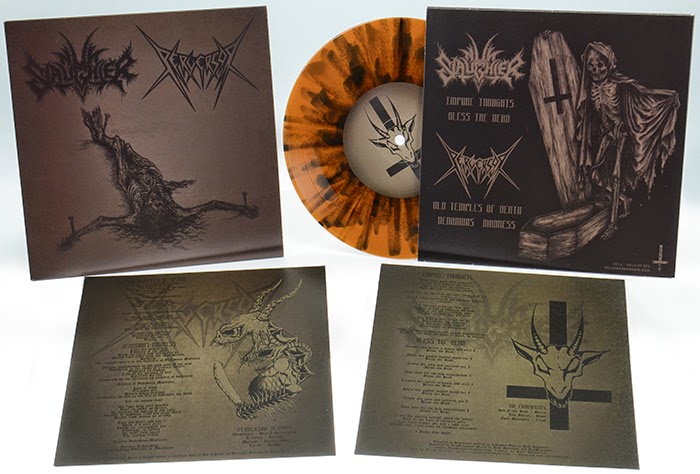
NunSlaughter return with incredible design and splatter vinyl and penetrating metal to match. “Impure Thoughts” open this seven inch, as NunSlaughter remind you why they are the kings of Devil Metal. Sleazy and sexual in a wretched manner, NunSlaughter unleash punishing raw death metal with a crust-thrash-blackened twist. The vocal are growled but audible. You can distinguish each smattering of delectable evil. Stellar production and a sinister energy level show this band at their peak with two exclusive tracks.

Perversor come with the same vibe. Lower vocals make it harder to understand than their split mates, but the demonic intent is what matters in delivery and Perversor crushes it. The songs are fast are Hell. This side adheres to more straight forward death metal from these South American purveyors of Satanic smut. And if you missed it, it is fast as Hell. Dirty riffs meander through an atomic cloud of malicious music. Both tracks are at 3:15 and feel elongated due to how fast they are. The drummer truly elevates the effort of these killer tracks.


Witchtrap Split:
Same great effort put into the layout and grey and black splatter wax here. The  vibrant red of the record sleeve is attention grabbing. NunSlaughter again return with ill tracks. They kick the speed up until the break into a swinging death-thrash riff that slays all suckers. As a tribute to their Colombian split mates, Witchtrap, NunSlaughter have titled the respective tracks “La Ofrenda” and “Altar De La Muerta”. 

While Witchtrap raised the ante with “Sex Commander” and “The Devil’s on the Loose”. These tracks are not as low tuned or dark as NunSlaughter. They are still metal as fuck, though. A tougher version of NWOBHM or Kreator, Destruction, Sodom would be appropriate. The chorus of “I’m a Sex Commander” certainly has me naked in my apartment with a towel for a cape. This is empowerment.

Afucking Plus for package and design. Support this and buy some vinyl

RIYL: Possessed, Nekrofilth, Necroholocaust, AntiCimex, Nuclear Assault, Toxic Holocaust